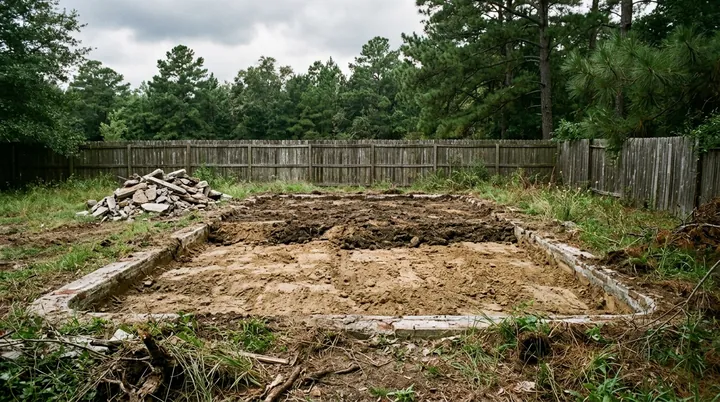
You can get rid of an in-ground pool with a partial fill-in or a full removal. With a partial fill-in, the top of the walls is broken and the shell is filled. With full removal, everything comes out, then the hole is filled and compacted.
The choice depends on what you plan to use that spot of yard for later and what your city allows. Figures from Angi and HomeGuide are as of October 2026.
What a partial fill-in leaves behind
Angi (updated July 8, 2026) says concrete pools are usually partially removed. The contractor breaks apart the concrete and mixes it with dirt to fill the cavity. HomeGuide (December 8, 2025) says partial demolition uses 12 inches of gravel at the base of the pool and describes filling it with the pool’s own rubble, dirt, and topsoil as the lowest-cost route.
Angi says a partial fill-in leaves part of the pool in the ground, which can decrease property value. It isn’t suitable for new buildings because of settling and drainage, according to Angi. Angi also says it must be disclosed to buyers and is illegal in some regions, and HomeGuide says some cities won’t allow partial removal. Angi says vinyl-lined and fiberglass pools need full removal.
What full removal involves
HomeGuide (December 8, 2025) describes full removal starting with an engineer’s demolition and compaction plan, followed by draining the water and removing accessories, the pump, filters, and lights. Gas and electrical lines are capped, the deck is pulled up, and the walls, floor, and drains are torn out. Concrete, gunite, fiberglass, steel, and rebar are hauled away. The area is filled with 80% compacted fill material and 20% topsoil, then graded.
Angi says local building codes may require an engineer to oversee removal and filling so the area drains, won’t sink or swell, and stays buildable. Angi’s published range for a structural engineer is $100 to $200 per hour. Angi says full removal prepares the area for new construction.
Costs side by side
Angi pool removal costs, updated July 8, 2026, lists average pool removal at $6,000, an in-ground partial fill-in at a published range of $2,500 to $10,000, full removal at a published range of $4,000 to $16,000, and pool removal at about $13.50 per square foot. Angi says full removal costs about double the average partial removal and also gives figures by pool size.
HomeGuide pool removal costs, dated December 8, 2025, lists published ranges of $2,000 to $10,300 for an in-ground partial fill-in, $4,300 to $16,400 for full removal, and $300 to $800 for above-ground pool removal, or $1,000 to $3,500 with a deck.
| In-ground pool (feet) | Partial fill-in | Full removal |
|---|---|---|
| 10 × 20 | $2,000–$6,200 | $4,300–$10,800 |
| 12 × 24 | $2,300–$7,700 | $4,600–$11,600 |
| 15 × 30 | $2,500–$8,100 | $4,100–$13,400 |
| 18 × 36 | $2,800–$9,300 | $5,600–$15,100 |
| 20 × 40 | $3,000–$10,300 | $6,100–$16,400 |
Angi average costs by pool size, updated July 8, 2026.
Which one fits your yard
If there’s any chance you’ll build on that spot, whether it’s an addition, garage, or shop slab, we recommend full removal. We’d make the same call if you’re selling soon. Angi says a partial fill-in isn’t suitable for new buildings and must be disclosed to buyers.
Partial fill-in fits when the spot will stay lawn or garden for good and your city allows it. For a vinyl or fiberglass pool, Angi says to go with full removal regardless. At the walkthrough, we’ll tell you which way we’d go on your yard.
How long it takes
Angi (updated July 8, 2026) says removing and filling an in-ground pool takes one to seven days. A partial fill-in can take up to three days, while a full removal may take an entire week, according to Angi. Angi (updated July 8, 2026) says draining takes about 24 hours and lists a cost of up to $175. Angi says to check with your municipality on where pool water can drain.